Built it fast? See where your app stands in 2 minutes. Free, and no email needed.
Fusion Advisory
Sample report

This is what a readiness review looks like.

A complete Compliance Readiness Review of Wrenfield Booking: the data map, the two-account test, ten findings tied to SOC 2, HIPAA, and PCI DSS, the plan, and the re-check after the fixes.

Wrenfield is a fictional company. We built its app with the mistakes we find most often in AI-built apps, then reviewed it the way we'd review yours. Every result below is real: our review script recorded each request and response as it ran. The records are fake.
Compliance Readiness Review
Wrenfield Booking
Online booking and card deposits for physical therapy clinics.
Prepared by Fusion Advisory
Prepared for
Wrenfield (fictional)
Reviewed
November 25, 2026
Test accounts
Alice at Harbor Street; Ben at Maple Row
Records
Fake patients, notes, and payments
SOC 2 · Security criteria

The clinic group asked for a SOC 2 report.

HIPAA · Security Rule

Wrenfield holds patient records for clinics, which makes it their business associate.

PCI DSS v4.0.1 · SAQ A

Patients pay deposits by card through the processor's embedded form.

The situation. Two founders built Wrenfield in eight weeks with an AI app builder on a hosted Postgres database. They're piloting it with two clinics on test records. A 40-clinic group wants a SOC 2 report and a signed business associate agreement before it rolls Wrenfield out, and patients pay deposits by card through the processor's embedded form.

1 · The short version

Ten findings. Two of them can't wait a day.

Critical2

Anyone on the internet can reach patient data or get past every access rule, with no sign-in.

High5

A signed-in user crosses clinic lines, or money or patient data is handled in a way that breaks a requirement.

Medium3

A protection, record, or eligibility condition is missing, without direct exposure on its own.

Fix these three first

  1. 1F2 The database's service key ships to every visitor's browser
  2. 2F1 Anyone with the app's public key can read every clinic's visit notes
  3. 3F7 AI summaries cross clinic lines and send patient identity to a provider with no BAA

What’s already working

  • ✓

    Patient records stay inside their clinic. The patients table has a correct clinic rule. Alice couldn't see a single Maple Row patient, and without a sign-in we saw none.

  • ✓

    Card numbers never touch Wrenfield. The card fields live inside the processor's own frame, and Wrenfield's server never receives card data. That's what keeps Wrenfield on SAQ A, the shortest PCI questionnaire.

  • ✓

    Passwords are stored safely. Sign-in passwords are stored as salted scrypt hashes, never as text. F6 is about where they leak on the way in.

Where you stand

SOC 2

Not ready to start an audit window. Nine findings touch the Security criteria, and an auditor testing access controls today would find F1 through F3.

HIPAA

Hold off on the clinic group's BAA, and on real patient data, until F1, F2, F3, and F7 are closed and your risk analysis reflects them.

PCI DSS

Card data is handled right. The open question is SAQ A eligibility (F8).

2 · Data map

What Wrenfield holds, where it lives, and who can reach it.

We traced each kind of sensitive data from the database and the code, then compared who should reach it with who could, in the app as built.

Visit notes
Lives in:
visit_notes table
Should reach it:
That clinic's staff
As built, reached by
  • ✗Anyone with the public key, no sign-in (F1)
  • ✗The AI provider, with no BAA (F7)
  • ✗The server log (F6)
Patient names, birth dates, phone numbers
Lives in:
patients table
Should reach it:
That clinic's staff
As built, reached by
  • ✓That clinic's staff only, through the app
  • ✗Anyone holding the service key from the JavaScript (F2)
  • ✗The AI provider gets names and birth dates (F7)
Appointment times and reasons
Lives in:
appointments table
Should reach it:
That clinic's staff
As built, reached by
  • ✗Every signed-in user at every clinic (F3)
Staff passwords
Lives in:
Sign-in service, as salted hashes
Should reach it:
Nobody, ever
As built, reached by
  • ✓Stored as salted hashes
  • ✗Written in plain text to the server log (F6)
Card numbers
Lives in:
The processor, inside its embedded frame
Should reach it:
The processor only
As built, reached by
  • ✓The processor only

Wrenfield’s vendor register, next to what the code sends

VendorThe register saysBAAWhat the code actually sends
Database and API hostHolds patient dataSigned✓Holds everything above
AI provider"No, just the notes"Not signed✗Notes, plus patient names and birth dates (F7)
Payment processorNo patient dataNot needed✓Card details, in its own frame
Chat widgetNot listedNot signed✗Runs on the payment page (F8)
Page analyticsNot listedNot signed✗Runs on the payment page (F8)
3 · The two-account test

Can one clinic see another clinic's patients?

We signed in as Alice at Harbor Street and tried to reach Maple Row's records. Then we tried again with no sign-in at all, using only the key that ships in the app.

  1. ✓
    Alice, signed in at Harbor Street, reads patients

    Patients stay inside their clinic: Alice sees only Harbor Street's patients, and no sign-in sees none.

  2. ✗
    Alice reads appointments

    Alice, signed in at Harbor Street, reads 2 of Maple Row's appointments, with the reason for each visit.

  3. ✗
    Alice reads visit notes

    Alice reads 2 of Maple Row's visit notes.

  4. ✗
    Alice edits a Maple Row visit note

    Alice changes another clinic's visit note, and the change saves.

  5. ✗
    No sign-in at all, just the public key, reads visit notes

    No sign-in needed: the public key alone returns all 4 visit notes, from both clinics.

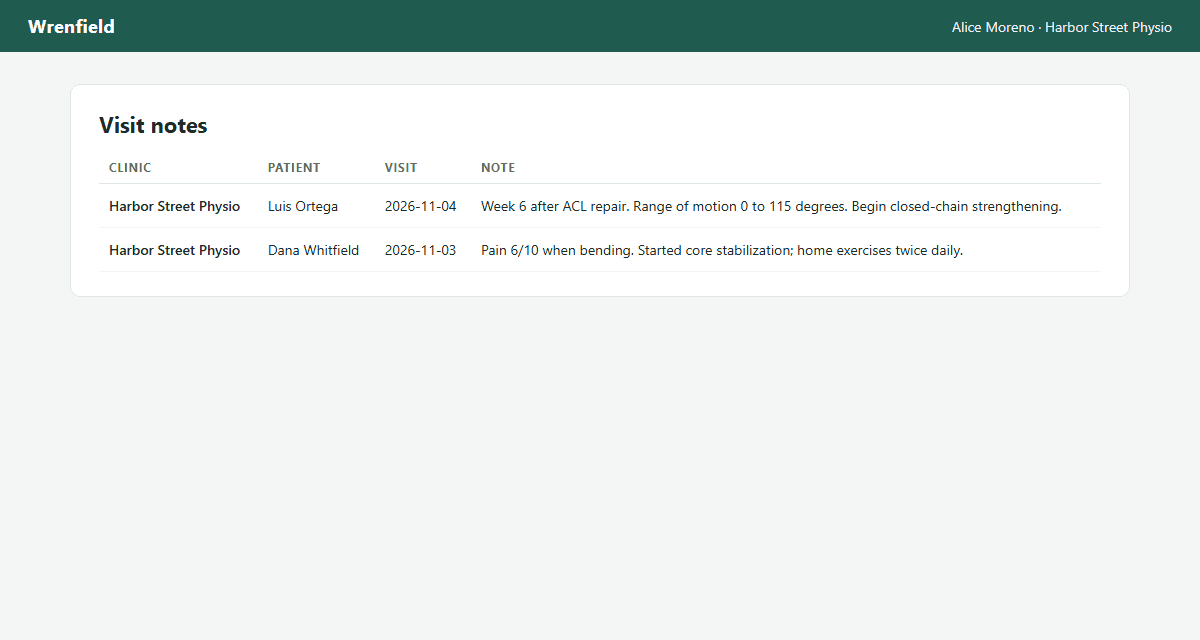
Wrenfield's clinic dashboard, signed in as Alice at Harbor Street Physio, listing two visit notes from Maple Row Physical Therapy above her own clinic's notes.
Alice’s own dashboard, signed in at Harbor Street. The top two notes belong to Maple Row’s patients.
4 · Findings

Ten findings, most severe first.

Each finding says what we found, why it matters, where it lands in SOC 2, HIPAA, and PCI DSS, and how to fix it. Open the evidence to see every request we sent and what came back.

CriticalF1

Anyone with the app's public key can read every clinic's visit notes

What we found

Row level security was never turned on for the visit notes table. The public key, which ships in the app's JavaScript by design, is enough to read every note from every clinic without signing in. Signed in at Harbor Street, Alice also read Maple Row's notes and changed one of them.

Why it matters

Visit notes are the most sensitive records Wrenfield holds. With real patients, anyone who found the key could have read every note, and with no access record (F10) Wrenfield couldn't show that nobody did. Under HIPAA, an impermissible disclosure is presumed to be a breach unless a risk assessment shows a low probability the information was compromised, and a business associate must tell the clinic no later than 60 days after discovering one.

The fix

Turn row level security on for visit notes with the clinic rule the patients table already uses, and send reads and edits through two database functions that check the clinic and record who did what. Those functions also close F10.

Effort: About a day, with tests · Plan: week 1

Where it lands

SOC 2
  • CC6.1 Logical access security over protected information
  • CC6.3 Access granted by role, with least privilege
HIPAA
  • §164.312(a)(1) Access control
  • §164.308(a)(4) Information access management
  • §164.410 A business associate's breach notice to the covered entity
PCI DSS

Not affected: no card data involved

Evidence: 3 steps, recorded as the review ranShow

Clinic IDs starting a0 are Harbor Street Physio; b0 are Maple Row Physical Therapy. Keys and tokens are shortened here; the requests carried them in full.

  1. 1. Read visit notes with only the public key, no sign-in
    GET /rest/v1/visit_notes?select=clinic_id,note
    apikey: eyJhbGciOiJIUzI1NiIs…  (public key, from the app's JavaScript)
    200 OK
    [
      {
        "clinic_id": "a0000000-0000-4000-8000-000000000001",
        "note": "Pain 6/10 when bending. Started core stabilization; home exercises twice daily."
      },
      {
        "clinic_id": "a0000000-0000-4000-8000-000000000001",
        "note": "Week 6 after ACL repair. Range of motion 0 to 115 degrees. Begin closed-chain strengthening."
      },
      {
        "clinic_id": "b0000000-0000-4000-8000-000000000001",
        "note": "Painful arc 70 to 120 degrees. Rotator cuff strengthening; no overhead lifting for 3 weeks."
      },
      {
        "clinic_id": "b0000000-0000-4000-8000-000000000001",
        "note": "Fall at home last month. Timed up-and-go 14 seconds. Start balance program; review home hazards."
      }
    ]
  2. 2. Alice reads visit notes
    GET /rest/v1/visit_notes?select=clinic_id,note
    apikey: eyJhbGciOiJIUzI1NiIs…  (public key, from the app's JavaScript)
    Authorization: Bearer eyJhbGciOiJIUzI1NiIs…  (Alice's sign-in token, Harbor Street)
    200 OK
    [
      {
        "clinic_id": "a0000000-0000-4000-8000-000000000001",
        "note": "Pain 6/10 when bending. Started core stabilization; home exercises twice daily."
      },
      {
        "clinic_id": "a0000000-0000-4000-8000-000000000001",
        "note": "Week 6 after ACL repair. Range of motion 0 to 115 degrees. Begin closed-chain strengthening."
      },
      {
        "clinic_id": "b0000000-0000-4000-8000-000000000001",
        "note": "Painful arc 70 to 120 degrees. Rotator cuff strengthening; no overhead lifting for 3 weeks."
      },
      {
        "clinic_id": "b0000000-0000-4000-8000-000000000001",
        "note": "Fall at home last month. Timed up-and-go 14 seconds. Start balance program; review home hazards."
      }
    ]
  3. 3. Alice edits a Maple Row note
    PATCH /rest/v1/visit_notes?id=eq.b00000c1-0000-4000-8000-000000000001
    apikey: eyJhbGciOiJIUzI1NiIs…  (public key, from the app's JavaScript)
    Authorization: Bearer eyJhbGciOiJIUzI1NiIs…  (Alice's sign-in token, Harbor Street)
    Prefer: return=representation
    
    {
      "note": "Painful arc 70 to 120 degrees. Rotator cuff strengthening; no overhead lifting for 3 weeks. (changed by Har…"
    }
    200 OK
    [
      {
        "id": "b00000c1-0000-4000-8000-000000000001",
        "clinic_id": "b0000000-0000-4000-8000-000000000001",
        "patient_id": "b0000001-0000-4000-8000-000000000001",
        "appointment_id": "b00000a1-0000-4000-8000-000000000001",
        "note": "Painful arc 70 to 120 degrees. Rotator cuff strengthening; no overhead lifting for 3 weeks. (changed by Har…",
        "created_at": "2026-11-05 14:45:00+00"
      }
    ]
✓

After the fix: Without a sign-in, the request is refused.
CriticalF2

The database's service key ships to every visitor's browser

What we found

The build copies every VITE_ setting into the JavaScript it sends to browsers, and the database's service key was one of them, there for the "Export all data" button. Anyone can open the file, copy the key, and read or change every table, because the service key skips every access rule.

Why it matters

This one key opens the whole database to anyone who looks, so no access rule in this report matters while it's public. Removing it from the code isn't enough either: it has already shipped, so it has to be replaced.

The fix

Take the service key out of the browser build, move the admin export to a server job, and rotate the database's signing secret so the copied key stops working. Then search the code history for other copies.

Effort: Half a day, plus a few minutes while the new keys go live · Plan: week 1

Where it lands

SOC 2
  • CC6.1 Logical access security over protected information
HIPAA
  • §164.312(a)(1) Access control
PCI DSS

Not affected: no card data involved

Evidence: 2 steps, recorded as the review ranShow

Clinic IDs starting a0 are Harbor Street Physio; b0 are Maple Row Physical Therapy. Keys and tokens are shortened here; the requests carried them in full.

  1. 1. Download the JavaScript the browser receives, and read the keys in it
    GET /assets/app.js
    200 OK
    VITE_DB_ANON_KEY: "eyJhbGciOiJIUzI1NiIs…"  (decodes to role "anon")
    VITE_DB_SERVICE_ROLE_KEY: "eyJhbGciOiJIUzI1NiIs…"  (decodes to role "service_role")
  2. 2. Use that service key to read patients
    GET /rest/v1/patients?select=clinic_id,full_name,date_of_birth
    apikey: eyJhbGciOiJIUzI1NiIs…  (service key, from the app's JavaScript)
    Authorization: Bearer eyJhbGciOiJIUzI1NiIs…  (same key)
    200 OK
    [
      {
        "clinic_id": "a0000000-0000-4000-8000-000000000001",
        "full_name": "Dana Whitfield",
        "date_of_birth": "1986-04-12"
      },
      {
        "clinic_id": "a0000000-0000-4000-8000-000000000001",
        "full_name": "Luis Ortega",
        "date_of_birth": "1979-09-30"
      },
      {
        "clinic_id": "b0000000-0000-4000-8000-000000000001",
        "full_name": "Priya Raman",
        "date_of_birth": "1991-02-17"
      },
      {
        "clinic_id": "b0000000-0000-4000-8000-000000000001",
        "full_name": "Tom Becker",
        "date_of_birth": "1964-11-05"
      }
    ]
✓

After the fix: The JavaScript now holds only the public key. The service key lives on the server, under a new signing secret.

HighF3

Every signed-in user sees every clinic's appointments

What we found

Row level security is on for appointments, but the read rule says yes to every signed-in user. Alice, at Harbor Street, read Maple Row's appointments, including the reason for each visit.

Why it matters

Appointment reasons are health information. A clinic that signs with Wrenfield expects its patients to be invisible to every other clinic, and so does HIPAA's access control standard. A rule like this is easy to miss because the table looks protected: the setting is on, but the rule lets everyone in.

The fix

Replace the rule with the clinic rule the patients table already uses.

Effort: About an hour, with tests · Plan: week 1

Where it lands

SOC 2
  • CC6.1 Logical access security over protected information
  • CC6.3 Access granted by role, with least privilege
HIPAA
  • §164.312(a)(1) Access control
  • §164.308(a)(4) Information access management
PCI DSS

Not affected: no card data involved

Evidence: 1 step, recorded as the review ranShow

Clinic IDs starting a0 are Harbor Street Physio; b0 are Maple Row Physical Therapy. Keys and tokens are shortened here; the requests carried them in full.

  1. 1. Alice reads appointments
    GET /rest/v1/appointments?select=clinic_id,starts_at,reason
    apikey: eyJhbGciOiJIUzI1NiIs…  (public key, from the app's JavaScript)
    Authorization: Bearer eyJhbGciOiJIUzI1NiIs…  (Alice's sign-in token, Harbor Street)
    200 OK
    [
      {
        "clinic_id": "a0000000-0000-4000-8000-000000000001",
        "starts_at": "2026-12-01 15:00:00+00",
        "reason": "Lower back pain after lifting"
      },
      {
        "clinic_id": "a0000000-0000-4000-8000-000000000001",
        "starts_at": "2026-12-02 16:30:00+00",
        "reason": "Knee rehab after ACL repair"
      },
      {
        "clinic_id": "b0000000-0000-4000-8000-000000000001",
        "starts_at": "2026-12-01 14:00:00+00",
        "reason": "Shoulder impingement, right side"
      },
      {
        "clinic_id": "b0000000-0000-4000-8000-000000000001",
        "starts_at": "2026-12-03 13:00:00+00",
        "reason": "Balance training after a fall"
      }
    ]
✓

After the fix: Alice now sees only Harbor Street's appointments.

HighF4

The payment webhook believes any message

What we found

Wrenfield's payment webhook marks an appointment paid whenever it receives a "checkout completed" event, without checking the processor's signature. We wrote an event ourselves, sent it, and the appointment showed as paid. No money moved.

Why it matters

Anyone who finds the address can mark deposits as paid. Security questionnaires ask how you verify payment events, and today the honest answer is that Wrenfield doesn't.

The fix

Verify the processor's signature on the raw request body, refuse anything unsigned, older than five minutes, or already handled, and check the amount paid against the checkout before marking anything paid.

Effort: Half a day · Plan: week 2

Where it lands

SOC 2
  • CC6.1 Logical access security over protected information
HIPAA

Not affected

PCI DSS

No card data is exposed, so this isn't a card-data requirement for an SAQ A merchant. It's still the most direct way to lose money.

Evidence: 2 steps, recorded as the review ranShow

Clinic IDs starting a0 are Harbor Street Physio; b0 are Maple Row Physical Therapy. Keys and tokens are shortened here; the requests carried them in full.

  1. 1. Send a payment event we wrote ourselves, with no signature
    POST /functions/v1/payment-webhook
    
    {
      "id": "evt_review_unsigned",
      "type": "checkout.session.completed",
      "data": {
        "object": {
          "amount_total": 100,
          "metadata": {
            "appointment_id": "a00000a2-0000-4000-8000-000000000001"
          }
        }
      }
    }
    200 OK
    {
      "received": true
    }
  2. 2. Check the appointment in the database
    select paid from appointments where id = 'a00000a2…'
    paid = true
✓

After the fix: Unsigned events are refused; a correctly signed event marks the appointment paid, once.

HighF5

The browser decides how much the deposit is

What we found

The deposit page sends the amount along with the appointment, and the checkout function charges whatever it's told. We asked for a $1 checkout on a $75 deposit and got one.

Why it matters

Anyone who changes one number in their browser pays what they like. Combined with F4, a deposit can be skipped entirely.

The fix

Send only the appointment from the browser, and look the deposit up on the server from the clinic's price list.

Effort: About two hours · Plan: week 2

Where it lands

SOC 2
  • PI1.2 Complete and accurate system inputs (Processing Integrity)

Only if your report covers Processing Integrity. Most first reports cover Security alone, but questionnaires still ask.

HIPAA

Not affected

PCI DSS

No card data is exposed, so this isn't a card-data requirement for an SAQ A merchant. It's still the most direct way to lose money.

Evidence: 1 step, recorded as the review ranShow

Clinic IDs starting a0 are Harbor Street Physio; b0 are Maple Row Physical Therapy. Keys and tokens are shortened here; the requests carried them in full.

  1. 1. Start a checkout for a $75 deposit, asking to pay $1
    POST /functions/v1/create-checkout
    apikey: eyJhbGciOiJIUzI1NiIs…  (public key, from the app's JavaScript)
    
    {
      "appointment_id": "a00000a1-0000-4000-8000-000000000001",
      "amount_cents": 100
    }
    200 OK
    {
      "session_id": "5df52f92-3690-4bf5-96e0-317d3c97823c",
      "amount_cents": 100,
      "embed_url": "https://pay.processor.example/embed?session=5df52f92-3690-4bf5-96e0-317d3c97823c&amount=100"
    }
✓

After the fix: The server ignores the browser's amount and charges the clinic's $75 deposit.

HighF6

Passwords and visit notes are written to the server log

What we found

The server writes every request body to its log, so each sign-in leaves the person's password in plain text, and each note edit leaves the note.

Why it matters

Logs get copied, shared with vendors, and kept for months, usually with looser access than the database. Patient notes in a log need the same protection as the database, and every password in this log has to be treated as known.

The fix

Log who did what and when, never request bodies. Delete the logs that hold passwords and notes, and have every user set a new password.

Effort: Half a day, plus the password reset · Plan: week 2

Where it lands

SOC 2
  • CC6.1 Logical access security over protected information
  • CC6.7 Information protected when it moves or is transmitted
HIPAA
  • §164.312(a)(1) Access control
  • §164.308(a)(1)(ii)(A) Risk analysis
PCI DSS

Not affected: no card data involved

Evidence: 1 step, recorded as the review ranShow

Clinic IDs starting a0 are Harbor Street Physio; b0 are Maple Row Physical Therapy. Keys and tokens are shortened here; the requests carried them in full.

  1. 1. Read the server's request log
    19 lines written during this review
    {"time":"2026-11-25T17:31:28.265Z","method":"POST","path":"/auth/v1/token?grant_type=password","status":200,"body":{"email":"alice@harborstreet.example","password":"harbor-street-demo-1"}}
    {"time":"2026-11-25T17:31:28.449Z","method":"PATCH","path":"/rest/v1/visit_notes?id=eq.b00000c1-0000-4000-8000-000000000001","status":200,"body":{"note":"Painful arc 70 to 120 degrees. Rotator cuff strengthening; no overhead lifting for 3 weeks. (changed by…
✓

After the fix: None of the 25 log lines hold a password or a patient detail; each records who did what, and when.Still open outside the code: Deleting the old logs and resetting every password. The re-check can only test the new logging.

HighF7

AI summaries cross clinic lines and send patient identity to a provider with no BAA

What we found

The "Summarize visit" function reads notes with the service key, so it skips the clinic rule: Alice summarized a Maple Row note. It also sends the patient's name and date of birth to the AI provider along with the note. Wrenfield's vendor register says the provider gets "just the notes", and no business associate agreement is in place.

Why it matters

Visit notes are patient health information, so an AI provider that receives them is a subcontractor under HIPAA and needs a signed BAA first. The name and date of birth aren't needed for a summary at all, and sending them breaks HIPAA's minimum necessary rule.

The fix

Read the note as the person asking, so the clinic rule applies and the read is recorded. Send only the note text. Sign a BAA with the AI provider, or switch to one that signs, before any patient data goes to it.

Effort: Half a day of code. The BAA depends on the provider. · Plan: week 1

Where it lands

SOC 2
  • CC6.1 Logical access security over protected information
  • CC9.2 Managing risk from vendors and business partners
HIPAA
  • §164.502(e) Disclosures to business associates need a written agreement
  • §164.308(b)(1) Business associate contracts, including with subcontractors
  • §164.502(b) Minimum necessary
  • §164.312(a)(1) Access control
PCI DSS

Not affected: no card data involved

Evidence: 2 steps, recorded as the review ranShow

Clinic IDs starting a0 are Harbor Street Physio; b0 are Maple Row Physical Therapy. Keys and tokens are shortened here; the requests carried them in full.

  1. 1. Alice asks for a summary of a Maple Row note
    POST /functions/v1/ai-visit-summary
    apikey: eyJhbGciOiJIUzI1NiIs…  (public key, from the app's JavaScript)
    Authorization: Bearer eyJhbGciOiJIUzI1NiIs…  (Alice's sign-in token, Harbor Street)
    
    {
      "note_id": "b00000c1-0000-4000-8000-000000000001"
    }
    200 OK
    {
      "summary": "Two-sentence summary returned by the AI provider stand-in."
    }
  2. 2. What reached the AI provider, recorded by our stand-in
    POST https://api.ai-provider.example/v1/summaries  (model: summary-small)
    The text sent, word for word:
    Summarize this physical therapy visit note in two sentences for the patient's chart.
    Patient: Priya Raman, born 1991-02-17
    Note: Painful arc 70 to 120 degrees. Rotator cuff strengthening; no overhead lifting for 3 weeks.
✓

After the fix: Another clinic's note is refused, and only the note text reaches the AI provider. The BAA with the provider is still open.Still open outside the code: The BAA with the AI provider. Until it's signed, summaries stay off for real patients.

MediumF8

The payment page runs other companies' scripts with no protection

What we found

The deposit page loads a chat widget and an analytics script from two outside companies, and sends no Content Security Policy. The processor's card form sits in its own frame, but any script on the page around it can change what the patient sees, including where that frame comes from.

Why it matters

Since January 2025, staying on SAQ A with an embedded payment form means confirming your site isn't susceptible to script attacks. Today Wrenfield can't confirm that, and if it can't, it no longer qualifies for SAQ A; the next option is a far longer self-assessment.

The fix

Move chat and analytics off the payment page, send a Content Security Policy that allows only your own scripts and the processor's frame, and get the processor's written confirmation, or add script monitoring, before you attest.

Effort: Half a day, plus the processor's confirmation · Plan: week 3

Where it lands

SOC 2
  • CC6.8 Preventing or detecting unauthorized or malicious software
  • CC9.2 Managing risk from vendors and business partners
HIPAA
  • §164.308(b)(1) Business associate contracts, including with subcontractors

Only if patients type health details into the chat: the chat vendor would then hold patient data, and it has no BAA.

PCI DSS

SAQ A eligibility criterion added in the January 2025 revision (PCI SSC FAQ 1588). The controls in requirements 6.4.3 and 11.6.1 are one way to meet it; the processor's written confirmation is another.

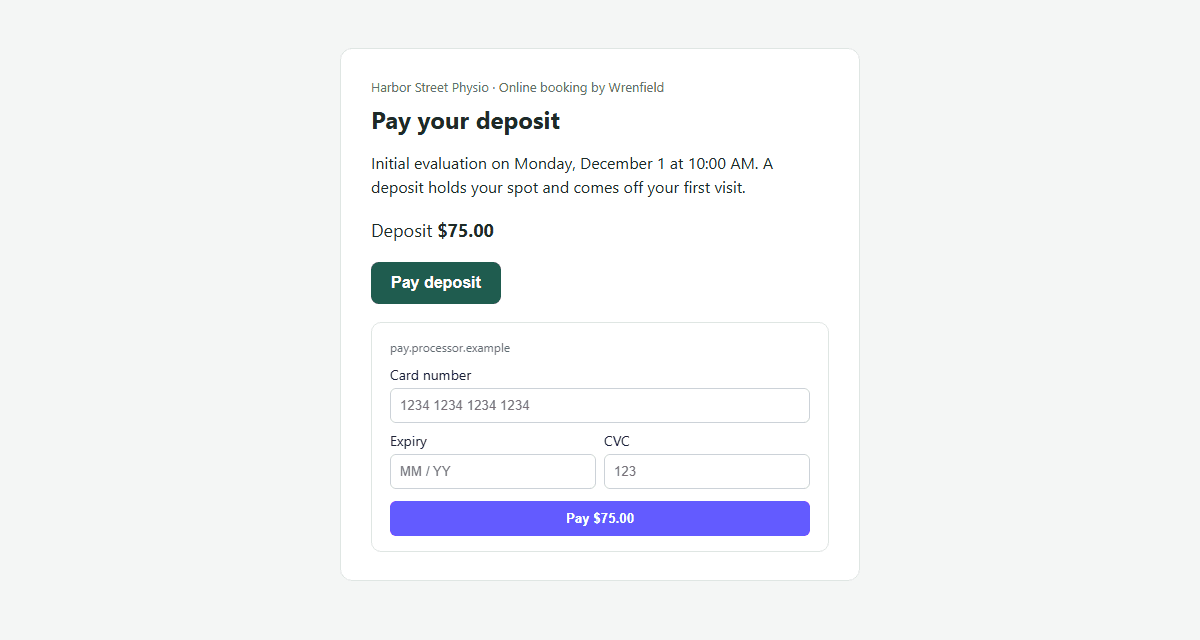
Wrenfield's deposit page as built, with an outside company's chat button in the corner and the processor's payment frame in the middle.
The deposit page as built. The chat button in the corner comes from an outside company’s script. The payment frame is our stand-in for the processor’s form.
Evidence: 1 step, recorded as the review ranShow

Clinic IDs starting a0 are Harbor Street Physio; b0 are Maple Row Physical Therapy. Keys and tokens are shortened here; the requests carried them in full.

  1. 1. Load the deposit page and list every script it runs
    GET /book?appointment=a00000a1…  (in a real browser)
    Scripts: widget.chatbubble.example/loader.js, wrenfield (this app)/assets/book.js, cdn.pagemetrics.example/track.js
    Payment frame: https://pay.processor.example/embed
    Content-Security-Policy: (none sent)
✓

After the fix: The payment page now loads only its own script, and a Content Security Policy limits it to this site and the processor's frame.Still open outside the code: The processor's written confirmation, or script monitoring, before you attest to SAQ A.

MediumF9

Nothing slows down password guessing

What we found

We sent eight wrong passwords for one account in a row, and each one was checked like the first. The AI summary function has no limit either, and every call costs money.

Why it matters

Without a limit, someone can try passwords against a clinic's staff accounts for as long as they like. Questionnaires ask about lockouts, and HIPAA asks you to monitor log-in attempts.

The fix

Pause sign-in after repeated failures (we used five in 15 minutes for one account from one address), and cap AI summaries per person per minute.

Effort: About two hours · Plan: week 3

Where it lands

SOC 2
  • CC6.1 Logical access security over protected information
  • CC7.2 Monitoring systems for signs of attacks and errors
HIPAA
  • §164.308(a)(5)(ii)(C) Log-in monitoring
  • §164.312(d) Person or entity authentication
PCI DSS

Not affected: no card data involved

Evidence: 1 step, recorded as the review ranShow

Clinic IDs starting a0 are Harbor Street Physio; b0 are Maple Row Physical Therapy. Keys and tokens are shortened here; the requests carried them in full.

  1. 1. Try eight wrong passwords for one account, back to back
    POST /auth/v1/token?grant_type=password  ×8
    {
      "email": "ben@maplerow.example",
      "password": "wrong-guess-0 … wrong-guess-7"
    }
    Statuses, in order: 400, 400, 400, 400, 400, 400, 400, 400
✓

After the fix: After 5 wrong passwords, sign-in pauses for 15 minutes (400, 400, 400, 400, 400, 429, 429, 429).

MediumF10

No record of who viewed or changed patient records

What we found

During this review Alice read every clinic's visit notes. Nothing in Wrenfield recorded which user read which record; the request log shows what was sent, not who sent it.

Why it matters

HIPAA requires audit controls that record activity in systems holding patient data. Without them, Wrenfield couldn't show a clinic who looked at a patient's notes, or prove that nobody misused F1 before it was fixed.

The fix

Record every read and change of a visit note (who, which record, when) where staff can't edit it, and review the record monthly. The functions in the F1 fix do the recording.

Effort: Included in the F1 fix, plus a monthly review · Plan: week 3

Where it lands

SOC 2
  • CC7.2 Monitoring systems for signs of attacks and errors
HIPAA
  • §164.312(b) Audit controls
  • §164.308(a)(1)(ii)(D) Information system activity review
PCI DSS

Not affected: no card data involved

Evidence: 1 step, recorded as the review ranShow

Clinic IDs starting a0 are Harbor Street Physio; b0 are Maple Row Physical Therapy. Keys and tokens are shortened here; the requests carried them in full.

  1. 1. Look for a record of who viewed or changed patient records
    select table_name from information_schema.tables where name like '%log%' or '%audit%'
    (no rows: there is no audit table, and the request log shows what was sent, not who sent it)
✓

After the fix: Every read and edit of a visit note is recorded: 3 entries for Alice's activity in this review.

5 · The plan

Three weeks, in order of risk.

Every finding comes with a fixed quote from FusionSales.ai, our software team, or your own team can take it on. Either way, we re-check the fixes.

Week 1

Close the doors: the leaked key, the missing and open access rules, and the AI feature

Week 2

Money and logs: payment events, deposit amounts, and what the server writes down

Week 3

The payment page, sign-in limits, and the access record

6 · The re-check

We fixed the app and ran every test again.

The same script, the same accounts, the same requests. Here is what changed, and what stays open until something outside the code is done.

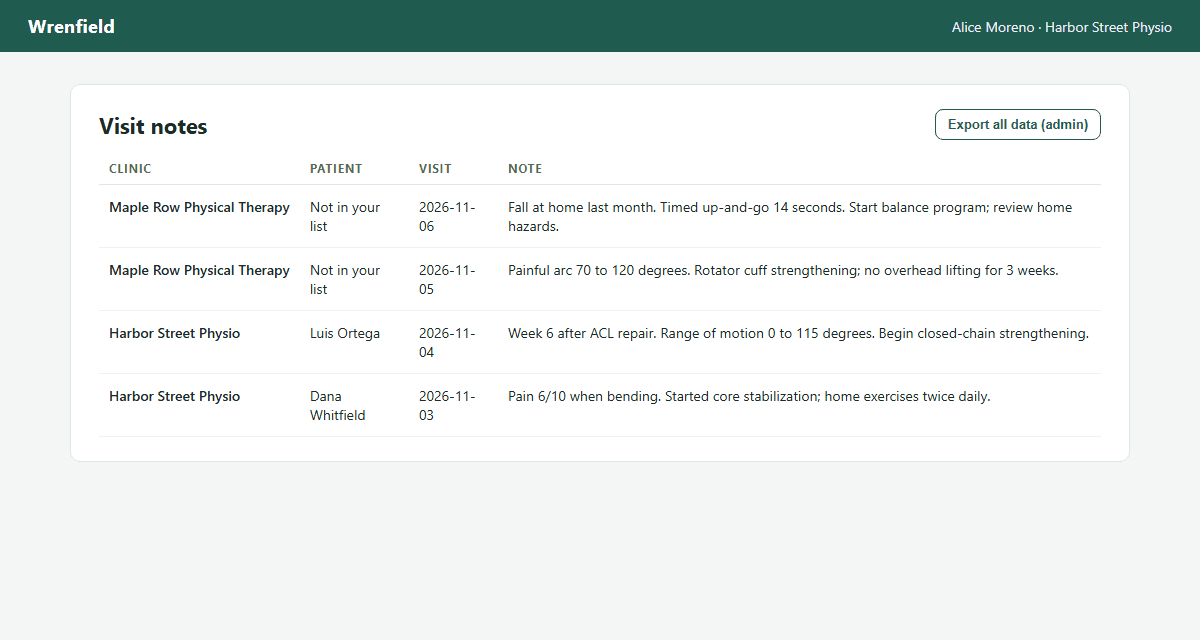
Wrenfield's clinic dashboard after the fixes, signed in as Alice, listing only Harbor Street Physio's notes.
After: Alice sees only Harbor Street’s notes.
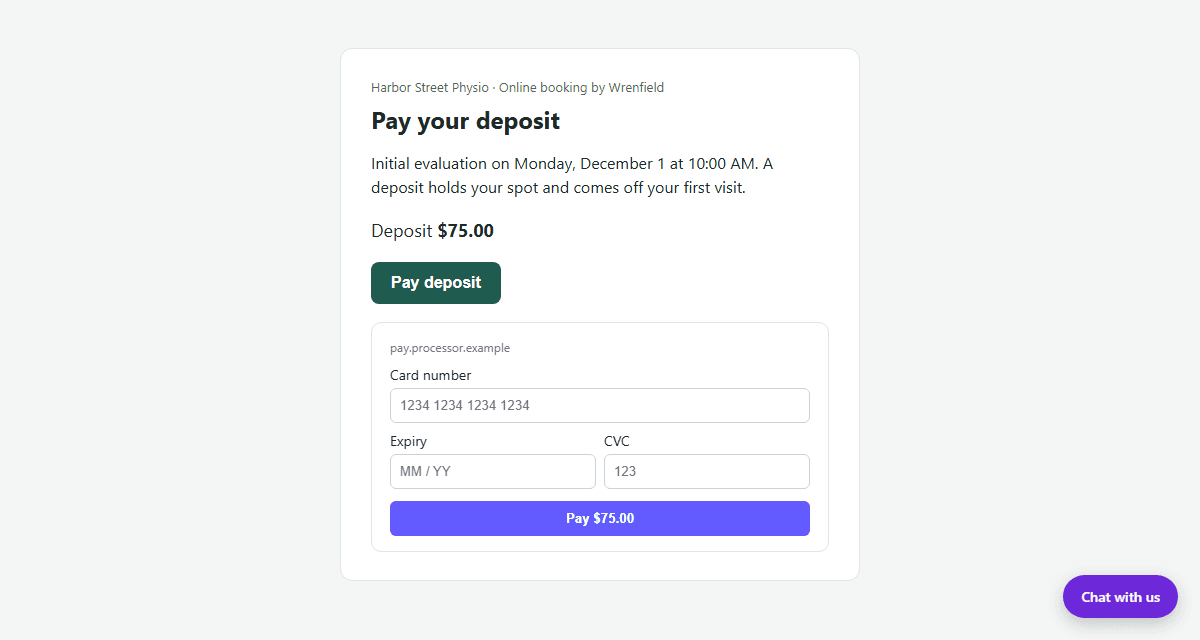
Wrenfield's deposit page after the fixes, with no outside chat button, only the payment frame.
After: the deposit page runs only its own script, under a Content Security Policy.
7 · How we ran it

What we did, and what a real review adds.

How we ran this sample

  • We reviewed Wrenfield's app with two test accounts at two clinics, Alice at Harbor Street and Ben at Maple Row, and fake records only.
  • Every request and response in this report was captured by our review script as it ran. Nothing was typed in afterward.
  • We stood in for two outside services: a recorder in place of the AI provider, so we could see exactly what leaves the app, and a stand-in for the processor's payment form.
  • We ran everything against a copy of the app on our own machine, never against a live system, and repeated every test after the fixes.

A real review also covers

  • Written policies and the HIPAA risk analysis
  • Vendor contracts, beyond Wrenfield's own vendor register
  • Backups and a test restore
  • Change management and code review
  • Staff access and offboarding
  • Cloud and network configuration
  • Live prompt-injection tests against the AI feature

We ask for the documents behind each of these and test what we can. A full penetration test is a separate engagement. We aren’t a CPA firm or a PCI Qualified Security Assessor, and this report is not an audit or a certification: it gets you ready for the people who issue those.

References used in this report

SOC 2 CC6.1Logical access security over protected information
SOC 2 CC6.3Access granted by role, with least privilege
SOC 2 CC6.7Information protected when it moves or is transmitted
SOC 2 CC6.8Preventing or detecting unauthorized or malicious software
SOC 2 CC7.2Monitoring systems for signs of attacks and errors
SOC 2 CC9.2Managing risk from vendors and business partners
SOC 2 PI1.2Complete and accurate system inputs (Processing Integrity)
HIPAA §164.308(a)(1)(ii)(A)Risk analysis
HIPAA §164.308(a)(1)(ii)(D)Information system activity review
HIPAA §164.308(a)(4)Information access management
HIPAA §164.308(a)(5)(ii)(C)Log-in monitoring
HIPAA §164.308(b)(1)Business associate contracts, including with subcontractors
HIPAA §164.312(a)(1)Access control
HIPAA §164.312(b)Audit controls
HIPAA §164.312(d)Person or entity authentication
HIPAA §164.410A business associate's breach notice to the covered entity
HIPAA §164.502(b)Minimum necessary
HIPAA §164.502(e)Disclosures to business associates need a written agreement
PCI DSS SAQ AEligibility: confirm the site isn’t susceptible to script attacks (2025 revision, FAQ 1588)
PCI DSS 6.4.3, 11.6.1Payment page script management, and tamper detection on payment pages

SOC 2 references are the AICPA Trust Services Criteria. HIPAA references are sections of 45 CFR Part 164. PCI DSS references are to version 4.0.1.

Want this report for your app?

Start with the intake. We scope your review and show you the quote before any work starts. We start 4 new readiness reviews a month.